
How to choose the right CNC aluminum enclosure for electronics
Introduction
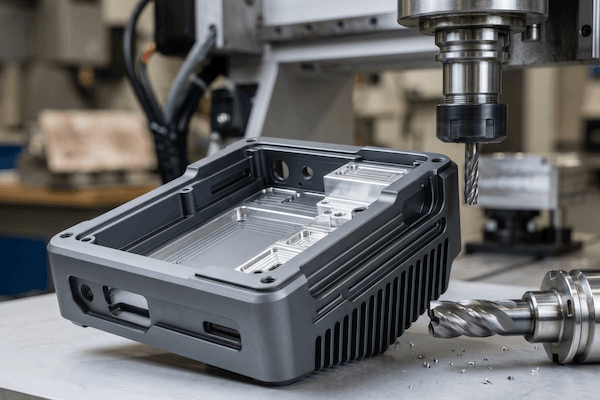
UN custom CNC aluminum enclosure is a precision-machined metallic housing designed to provide structural integrity, passive thermal management, electromagnetic interference (EMI) shielding, and ingress protection (IP rating) for printed circuit board assemblies (PCBAs) in demanding industrial and commercial applications.
Modern electronic devices are becoming increasingly highly integrated, generating unprecedented thermal loads while being deployed in extreme operational environments—from rugged outdoor telecom stations to harsh industrial IoT floors. A poorly specified enclosure is the single greatest threat to a high-value motherboard, often leading to catastrophic field failures through thermal throttling, moisture ingress, or short circuits.
Selecting the right housing is far more complex than merely "buying a metal box." Hardware engineers must engineer the perfect equilibrium between thermal dissipation efficiency, EMI/RFI shielding effectiveness, rigorous IP-rated environmental sealing, and scalable manufacturing costs. Relying on sub-optimal materials or ignoring DFM (Design for Manufacturing) principles will inevitably compromise your product's lifecycle and regulatory compliance. (For standard environmental baseline requirements, refer to the IEC IP Rating guidelines).
By the end of this comprehensive guide, you will master the 5 critical steps to selecting and designing the perfect CNC aluminum enclosure for your electronic products, ensuring robust hardware performance from rapid prototyping to mass production. To learn more about optimizing your manufacturing process, explore our Custom CNC Machining Services.
1. What is Material Selection for CNC Electronic Enclosures?
In the context of custom CNC machining, material selection is the strategic engineering process of choosing the optimal aluminum alloy grade based on the device's required structural integrity, environmental exposure, cosmetic finishing capabilities, and overall manufacturing budget.
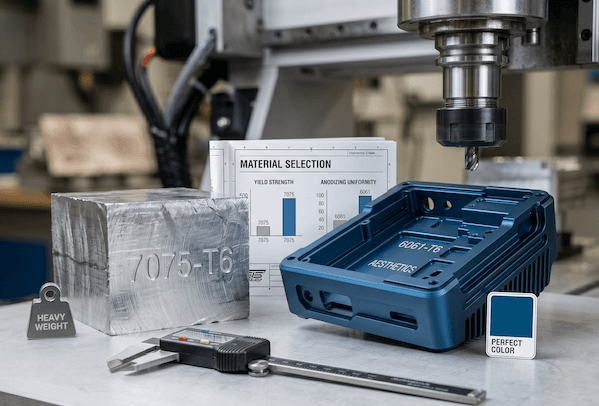
When engineering a custom CNC aluminum enclosure, staring at endless data sheets of tensile strengths and thermal properties often leads to analysis paralysis. Instead of getting bogged down by raw physics, hardware engineers should focus on real-world application scenarios. The ultimate showdown usually comes down to two heavyweights: Aluminum 6061-T6 vs. Aluminum 7075-T6.
-
Aluminum 6061-T6 (The Ultimate "Jack-of-all-Trades"): For 90% of commercial and industrial electronic housings, 6061-T6 is the undisputed champion. It offers an unbeatable balance of machinability and cost-effectiveness. More crucially for consumer-facing devices, 6061 aluminum yields the highest quality anodizing results, delivering a flawless, uniform color finish without surface blotching. If you want that premium, sleek aesthetic similar to high-end laptops, this is your go-to material.
-
Aluminum 7075-T6 (The Aerospace Heavyweight): Boasting a yield strength nearly double that of 6061, 7075 is engineered for extremes. However, this superior strength comes with significant drawbacks for standard electronics. It is significantly more expensive to source and machine. Furthermore, due to its high zinc and copper alloying elements, 7075 is notoriously difficult to anodize uniformly, often resulting in unpredictable color variations or a yellowish tint.
💡 Pro Engineering Verdict: Unless your product requires extreme ballistic protection, military-grade drop resistance, or explosion-proof certifications, avoid the high costs of 7075. Stick with Aluminum 6061-T6 to ensure maximum cosmetic yield and a highly cost-effective DFM (Design for Manufacturing) strategy.
For a deeper dive into the chemical compositions of these alloys, you can reference the Aluminum Association's Alloy Designations. Need help deciding? Consult our Material Selection & Services de prototypage to evaluate the best fit for your next PCBA housing.
2. What is Thermal Management in CNC Enclosures?
Thermal management dans CNC aluminum enclosures is the strategic engineering practice of utilizing the robust metallic housing itself as a primary passive heat sink, efficiently transferring thermal energy away from high-power printed circuit board assembly (PCBA) components to the external environment.
As processor speeds accelerate and power outputs surge, keeping your chips cool is a non-negotiable design requirement. While sheet metal bending lacks the material thickness required for high-volume heat transfer, and traditional die-casting often suffers from internal porosity that disrupts thermal conductivity, CNC machining delivers a distinct thermodynamic advantage.
Custom CNC machining allows hardware engineers to mill integrated heatsink fins directly into the solid exterior chassis. This continuous, monolithic metal structure entirely eliminates the thermal contact resistance typically found when attaching separate external heat sinks, maximizing the surface area exposed to ambient airflow for superior passive cooling performance.
💡 Pro Engineering Tip: Design precision-milled thermal pedestals (bosses) on the interior floor of your enclosure. Never leave an insulating air gap above your critical heat-generating components like CPUs, power amplifiers, or motor drivers. These raised aluminum platforms should be mathematically aligned with the ICs on your PCB. Pair these machined pedestals with appropriately sized thermal interface materials (TIMs), such as thermal silicone pads, to bridge microscopic surface irregularities. This creates a direct, uninterrupted thermal pathway from the silicon die straight to the outer cooling fins.
For further reading on heat transfer dynamics in electronics, you can review the ASME Journal of Electronic Packaging. To see how we can optimize your fin geometry for manufacturability, explore our Precision CNC Milling Services.

3. What is EMI/RFI Shielding in Aluminum Enclosures?
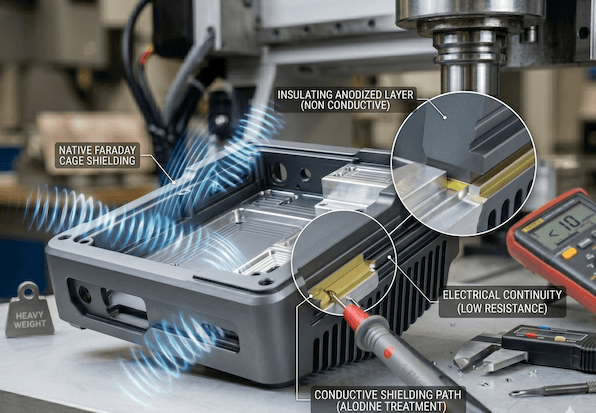
Electromagnetic Interference (EMI) and Radio Frequency Interference (RFI) shielding is the engineering practice of utilizing a conductive metal housing to create a continuous Faraday cage, preventing external electromagnetic noise from disrupting internal sensitive PCBAs while containing internal signal emissions to meet strict regulatory compliance (such as FCC and CE).
Why do high-end telecom base stations and precision medical diagnostic equipment strictly avoid plastic housings? Plastics are virtually transparent to electromagnetic waves, offering zero inherent defense against signal disruption. In contrast, custom CNC aluminum enclosures provide superior, natural EMI/RFI shielding. Aluminum acts as a highly effective conductive barrier that absorbs and reflects electromagnetic radiation, ensuring flawless signal integrity for high-frequency and mission-critical electronics.
However, hardware engineers frequently fall into a critical surface finishing trap that compromises this natural defense. Standard Type II or Type III anodizing creates a durable aluminum oxide layer, but this layer is a strict electrical insulator. If the top and bottom shells of your enclosure are fully anodized, they will not share electrical continuity when bolted together. This effectively breaks the Faraday cage, leading to immediate EMC (Electromagnetic Compatibility) testing failures.
💡 Pro Engineering Tip: To maintain a continuous shielding perimeter and proper chassis grounding, you must specify selective masking on all mating surfaces, screw threads, and grounding points prior to anodizing. Alternatively, a more robust solution for internal sections is to apply a conductive chromate conversion coating (such as Alodine, SurTec 650, or MIL-DTL-5541). This treatment ensures low electrical contact resistance while protecting the bare metal from corrosion.
For a deeper understanding of compliance testing, you can refer to the IEEE Electromagnetic Compatibility Society. To ensure your DFM strategy passes certification on the first try, consult our Advanced Surface Finishing & Masking Services.
4. What is an IP Rating for CNC Enclosures?
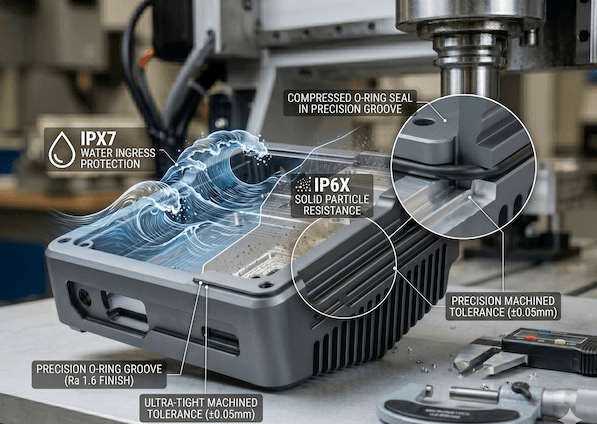
Un Ingress Protection (IP) rating, such as IP65 or IP67, defines a mechanical enclosure's certified ability to seal internal electronic components against the intrusion of solid particles (dust) and liquids (water). For custom aluminum enclosures, this high-level environmental defense is achieved through precision-machined mechanical sealing interfaces rather than simple adhesives.
Deploying IoT gateways outdoors or installing industrial controllers in washdown environments demands relentless weatherproofing. Achieving a true IP67 rating (submersible up to 1 meter) isn't about simply squeezing a rubber gasket between two plates; it fundamentally relies on extreme structural rigidity and dimensional accuracy.
Unlike bent sheet metal, which is prone to warping and flexing, coutume Usinage CNC delivers the ultra-tight tolerance control necessary to ensure the top and bottom chassis mate perfectly without any micro-gaps.
The core of a waterproof design lies in the DFM (Design for Manufacturing) of the sealing geometry. To secure your PCBA against the elements, hardware engineers must accurately design O-ring grooves or Form-in-Place (FIP) dispensing grooves directly into the CNC CAD files.
💡 Pro Engineering Tip: The width, depth, and surface roughness of your CNC-machined O-ring groove are the absolute determining factors for IP67 sealing effectiveness. If the machined floor of the groove is too rough (e.g., above Ra 1.6), water will bypass the gasket via microscopic capillary action. Furthermore, the groove's dimensional volume must be mathematically calculated to allow for the exact 20% to 30% rubber compression ratio without pinching or over-extruding the seal.
For comprehensive guidelines on environmental testing, you can review the NEMA Enclosure Types standards. To ensure your O-ring grooves are machined to watertight perfection, explore our Precision Tolerance Services d'usinage CNC.
Prêt à commencer ?
Besoin d'aide avec Boîtiers en aluminium sur mesure? Contactez RALLY dès aujourd'hui pour des conseils d'experts et une consultation gratuite !
5. What are surface finishes for CNC aluminum enclosures?
In custom hardware manufacturing, finition de surface is the final metallurgical or chemical process applied to a machined aluminum chassis to dramatically alter its exterior properties, enhancing its cosmetic aesthetics, corrosion resistance, and mechanical durability against environmental wear and tear.
Making the final cosmetic decision is critical because the exterior finish dictates both the product's market positioning and its lifespan. To help you navigate these choices, hardware engineers typically evaluate three primary finishing techniques based on the end-use environment:
-
Sandblasting + Type II Anodizing (The Consumer Standard): This electrochemical process is the absolute go-to for premium commercial electronics. By blasting the enclosure with fine media and applying a controlled oxide layer, you achieve an ultra-premium, scratch-resistant matte texture—identical to the sleek, luxurious feel of an Apple MacBook chassis. It offers excellent corrosion resistance and allows for uniform color dyeing.
-
Type III Hard Anodizing (The Industrial Shield): Engineered for extremes, this process creates an oxide layer that is significantly thicker and denser than Type II. Specify Type III Hard Anodizing when designing ruggedized equipment for military (MIL-SPEC) or harsh industrial applications that demand extreme abrasion resistance and dielectric strength. Keep in mind, color options are typically limited to dark gray or black due to the dense coating.
-
Powder Coating (The Blemish Hider & Color Master): This involves applying a dry thermoplastic powder that is thermally cured (baked) onto the metal. Powder coating is your best option if your industrial design demands a highly unique, vibrant custom color palette (RAL colors), or if you need an economical way to completely mask underlying CNC machining tool marks and raw aluminum defects.
💡 Pro Engineering Tip: Always account for coating thickness in your 2D CAD DFM (Design for Manufacturing) tolerances. Type II anodizing only adds a negligible 0.005mm to 0.025mm, whereas powder coating can add a massive 0.05mm to 0.15mm of material thickness, which will severely cause interference fits in precision mating assemblies and threaded holes if not accommodated for in the machining stage.
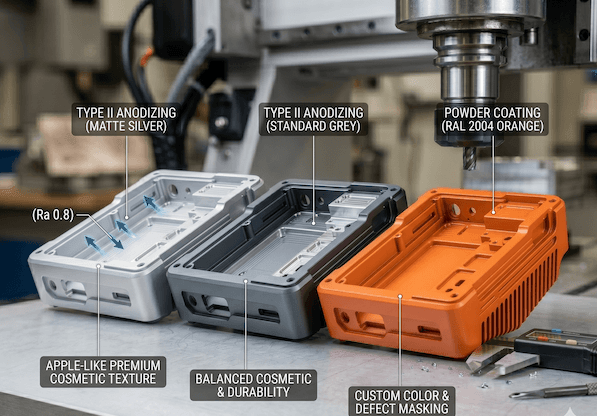
Table: CNC Aluminum Surface Finishes Comparison
| Surface Finish Type | Primary Engineering Benefit | Ideal Application Scenario | Relative Cost |
| Type II Anodizing | Premium cosmetic texture, good scratch resistance | High-end consumer electronics, Audio interfaces | Moyen |
| Type III Hard Anodizing | Extreme abrasion and wear resistance | Military gear, Rugged industrial controllers | Haut |
| Revêtement en poudre | Vivid custom colors, hides machining defects | Outdoor IoT gateways, Medical carts, Heavy machinery | Low to Medium |
For exact military specifications regarding anodizing thickness, refer to the MIL-A-8625 Standard. Need advice on dimensioning your CAD files for specific coatings? Explore our Custom Surface Finishing Services.
Conclusion
Choisir le bon CNC aluminum enclosure is critical to your product’s success. It’s not just a metal box; it's about striking the perfect balance between thermal performance, EMI shielding, environmental protection, and manufacturing cost.
Don't let complex DFM (Design for Manufacturing) challenges slow down your time-to-market. RALLY PRECISION is your trusted partner for high-quality custom CNC machining. We specialize in turning complex designs into reality, offering rapid prototyping (3-7 days) and reliable low-volume manufacturing with exceptional quality control.
Explorez notre Custom CNC Machining Services ou Contact RALLY PRECISION for a Free DFM Quote aujourd'hui.
Questions générales :
Obtenez un devis rapide pour votre nouveau projet !
Notre équipe d'experts et nos capacités de fabrication avancées sont prêtes à accompagner votre projet, du prototype à la production en série. Contactez-nous dès maintenant pour commencer !
Articles Similaires

Waveguide Flanges: The Ultimate Guide to Types, Standards, and Selection

Aluminium anodisé noir : tout ce que vous devez savoir

Le guide ultime de l'usinage du Delrin

 French
 German
 Portuguese
 Polish
 Spanish
 Italian
 English