
From Drawing to Production: Custom Brass Pins & Sockets Guide
Introduction
Are you currently struggling to fit a standard off-the-shelf connector into your sleek new device design?
As a design engineer, toi know the frustration all too well: standard components often dictate your housing dimensions, force compromises on current ratings, or simply fail to provide the precise tactile feel your product demands.
For too long, there has been a misconception that custom brass pins and sockets require expensive tooling fees and months of lead time. Consequently, many teams settle for standard parts, unknowingly sacrificing product performance or increasing assembly complexity.
The good news? That trade-off is no longer necessary. Thanks to advancements in modern precision turning technology, customization has become agile, scalable, and surprisingly cost-effective. At RALLIER, we are here to bridge the gap between your unique vision and manufacturing reality. In this guide, we will walk you through our proven 4-step process, revealing exactly how to transform your CAD drawings into high-performance, mass-produced realities—faster than you ever thought possible.

Why Choose Brass for Custom Connector Contacts?
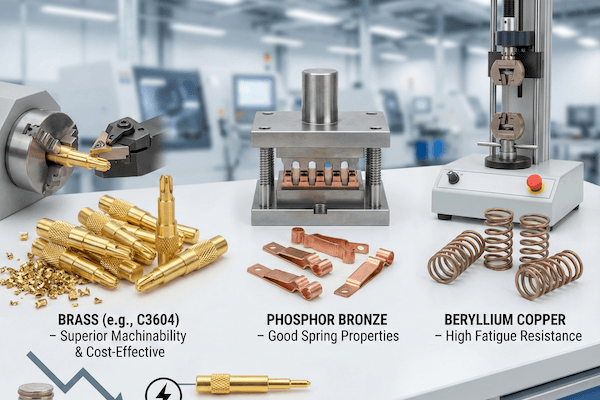
Selecting the right base material is the first step in successful interconnect design. While Phosphor Bronze offers good spring properties and Beryllium Copper (BeCu) excels in high-fatigue environments, Laiton remains the undisputed champion for turned components.
Here is why engineers prefer custom brass pins for precision applications:
-
Superior Machinability Brass alloys, such as C3604 (Free-cutting Brass), are ideal for CNC Swiss machining. Unlike sticky copper alloys, brass chips break easily during cutting. This property allows RALLY to manufacture complex geometries, including micro-holes, moletage, and fine threads, with extreme precision. [Learn more about our CNC capabilities].
-
Unmatched Cost-Effectiveness For high-volume projects, budget is a priority. Brass is significantly cheaper than Beryllium Copper. Furthermore, its ease of machining reduces tool wear and speeds up production. Therefore, brass connector sockets offer the most economical solution for production de masse without compromising quality.
-
Reliable Conductivity Raw material conductivity is only half the story. When paired with professional traitement de surface, brass performs exceptionally well. Applying Gold or Tin plating ensures your electrical contact pins achieve low contact resistance and stable signal transmission comparable to premium alloys.
The 4-Step Process: Bringing Your Custom Pins to Life
At RALLY, we do not just manufacture parts; we engineer solutions. We have streamlined our production workflow to ensure your custom brass pins and sockets move from concept to reality with speed and precision.
Here is how we handle your project:
Step 1: Engineering & DFM Review
Before a single machine starts running, our engineering team performs a comprehensive DFM (Design for Manufacturing) analysis. We do not just read your drawings; we optimize them.
-
Tolerance Optimization: We review your specified tolerances. If a non-critical dimension demands an expensive +/-0.005mm tolerance, we will suggest a cost-effective adjustment to +/-0.02mm without affecting functionality.
-
Cost Reduction: We identify design features that might unnecessarily increase machining time, ensuring you get the best performance at the lowest unit cost.

Step 2: Rapid Prototyping
Time-to-market is critical. We utilize advanced CNC Swiss Machining centers for prototyping. unlike traditional Cam Lathes (which require time-consuming setup), Swiss machines allow us to program and produce complex samples directly from digital files.
The Result: We can ship high-precision functional samples in as little as 5-7 working days, allowing you to validate your design immediately.

Step 3: Precision Manufacturing
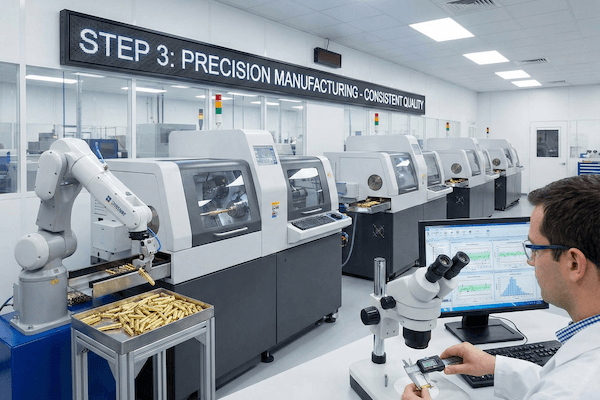
Once samples are approved, we transition to mass production. Whether you need 10,000 or 1,000,000 pieces, consistency is key. Our workshop combines high-speed automatic lathes with rigorous process control. This ensures that the last brass pin off the line is identical to the first, guaranteeing smooth assembly on your production line.
Step 4: Surface Treatment
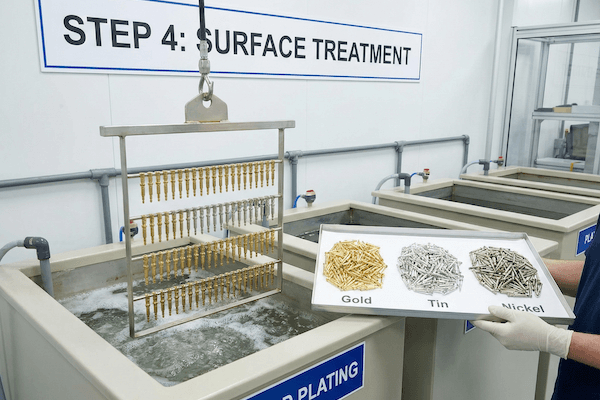
The base material is only the beginning. We guide you in selecting the right plating to match your application environment:
-
Gold Plating: Selected for high-reliability signal transmission and corrosion resistance.
-
Tin Plating: The go-to choice for excellent solderability and cost efficiency.
-
Nickel Plating: Used as a crucial underlayer to prevent copper diffusion and increase durability.
Critical Design Features We Can Customize
Standard catalog parts often fail because they lack the specific mechanical features required for unique housings. At RALLIER, we go beyond simple cylinders. We engineer custom brass pins with functional details that enhance assembly efficiency and product longevity.
Here are three advanced customization capabilities that set us apart:
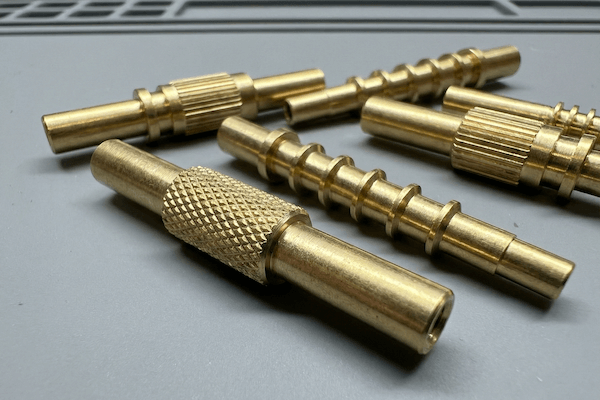
Knurling & Barbs (For Insert Molding)
If your pin needs to be molded into plastic, retention is critical. A smooth pin will pull out or rotate under stress.
Torque Resistance: We machine precise Diamond or Straight Knurling patterns that bite into the plastic, preventing the pin from spinning.
Pull-Out Force: We create aggressive undercuts and barbs. These features act like anchors, significantly increasing the force required to dislodge the pin from the housing.
Slotted & Crimping Zones (For Wire Termination)
The connection between the pin and the wire is just as important as the mating interface.
Solder Cups: We drill blind holes with precise depth control to facilitate easy soldering.
Crimping Barrels: We machine thin-walled sections designed to be crimped around wire strands securely.
Expansion Slots: For male pins requiring elasticity, we can saw or mill longitudinal slots, creating a spring effect for a secure interference fit.

Complex Geometries (Beyond the Centerline)
Modern designs require more than just turning on a center axis. Our CNC Swiss Machining capabilities allow for:
Eccentric Holes: Drilling holes off-center for specific alignment keys.
High Aspect Ratios: Machining extremely long, thin pins (e.g., length is 20x the diameter) without bending or warping.
Side Drilling: Creating perpendicular holes through the side of the pin for locking mechanisms or airflow.

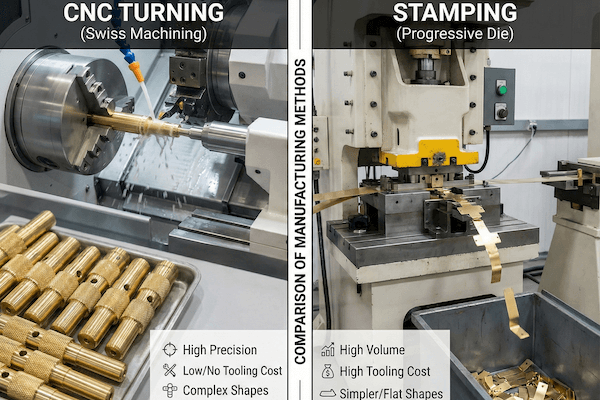
Comparison of Manufacturing Methods (CNC Turning vs. Stamping)
Choosing the right process is vital for your budget. We offer both.
| Fonctionnalité | CNC Turning (Swiss Machining) | Precision Stamping |
| Ideal Quantity | Low to Medium (500 - 100k pcs) | High Volume (100k+ pcs) |
| Tooling Cost | None / Very Low (Program-based) | Haut (Requires Progressive Dies) |
| Shape Complexity | High (Undercuts, threads, knurls) | Medium (Flat, formed, or rolled shapes) |
| Précision | Ultra-High ($\pm0.005$mm) | High ($\pm0.02$mm) |
| Material Usage | High scrap rate (chips) | Efficient material utilization |
Ensuring Reliability: Plating and Tolerance Control
UN custom brass pin is only as good as its surface finish and dimensional accuracy. At RALLY, we employ a rigorous quality control (QC) regime to ensure every part withstands the harsh realities of the real world.
Precision Plating Control (The Invisible Shield)
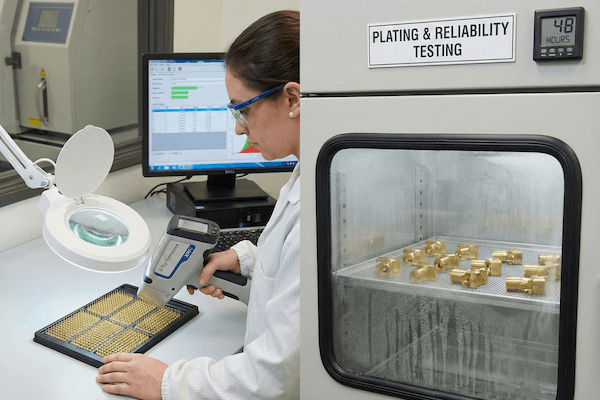
Plating defects are the leading cause of field failures. We do not guess; we measure.
-
X-Ray Thickness Measurement (XRF): Using advanced X-Ray Fluorescence technology, we verify plating thickness to the micro-inch. This ensures you are not paying for excess gold, nor receiving a coating too thin to protect against oxidation.
-
Salt Spray Test (Corrosion Resistance): We subject our plated parts to ASTM B117 standard salt fog chambers (e.g., 24h, 48h, or 96h). This validates that the brass connector sockets will not corrode in humid or marine environments.
Achieving +/- 0.005mm Tolérance
Hitting tight tolerances on a drawing is easy; maintaining them across a million parts is the challenge. We achieve $\pm0.005mm$ precision through:
-
Thermal Stability: Our workshop maintains a constant temperature to prevent material expansion.
-
Swiss-Type Lathes: We use rigid Citizen/Star machines where the guide bushing supports the workpiece, eliminating deflection.
-
Preventative Tool Management: We change cutting tools before they wear out, ensuring the dimensional consistency of every turned pin.
Recommended Plating Specs for Different Applications
Not sure what plating you need? Here is a quick guide based on our industry experience.
| Industrie | Recommended Plating | Typical Thickness | Key Benefit |
| Électronique grand public | Flash Gold over Nickel | 1u"-3u" Au | Cost-effective conductivity. |
| Automobile | Thick Gold or Matte Tin | 15u"-30u" Au | Vibration resistance & high heat durability. |
| Dispositifs médicaux | Hard Gold (Cobalt hardened) | 30u"-50u" Au | High reliability & bio-compatibility. |
| Industrial Control | Bright Tin over Nickel | 80u"-120u" Su | Excellent solderability & corrosion protection. |
Prêt à commencer ?
Besoin d'aide avec Custom Brass Pins & Sockets? Contactez RALLY dès aujourd'hui pour des conseils d'experts et une consultation gratuite !
Why Partner with a Chinese Manufacturer like RALLY?
It is no longer just about "low cost" in China; it is about sophisticated integration and scale. RALLY stands at the forefront of this evolution, proving that haute précision et prix compétitifs can coexist. We do not just sell parts; we offer a strategic advantage that rivals Western counterparts.
Our location in the heart of the world’s most robust electronics ecosystem provides unmatched Supply Chain Completeness. With raw material suppliers and specialized plating partners within a 50km radius, we eliminate the logistical bottlenecks that slow down production elsewhere. This proximity allows us to accelerate Vitesse to market, moving from DFM to mass production while other suppliers are still waiting for materials.
For RALLY, saving money doesn't mean cutting corners on quality. By leveraging automated Swiss-type machining and mature process control, we deliver the lowest "Total Landed Cost" for premium components. You get the engineering rigor you expect from a Global Tier-1 supplier, combined with the agility and scalability of Chinese manufacturing.

Conclusion
Customization should never be a bottleneck; it should be your competitive advantage. Throughout this guide, we have demonstrated that moving from a standard catalog part to a custom brass pin does not require sacrificing your budget or your timeline. With the right material selection, advanced CNC Swiss machining, and a robust quality control process, you can achieve the perfect fit for your application.
More Than Just a Factory À RALLIER, we refuse to be just another "print-to-part" machine shop. We position ourselves as your strategic engineering partner. When you choose us, you are not just buying brass terminals; you are gaining access to a team of experts dedicated to optimizing your DFM, reducing your costs, and accelerating your time-to-market. We combine the scale and efficiency of Chinese manufacturing with the engineering rigor of a global Tier-1 supplier.
Don't let off-the-shelf components limit your innovation. Whether you are in the concept phase or ready for mass production, our team is standing by to help.
Ready to start? Upload your drawing for a free DFM review today.
Questions générales :
Obtenez un devis rapide pour votre nouveau projet !
Notre équipe d'experts et nos capacités de fabrication avancées sont prêtes à accompagner votre projet, du prototype à la production en série. Contactez-nous dès maintenant pour commencer !
Articles Similaires

Plastique ou métal : comment choisir pour vos projets CNC ?

Pour quelles nuances d'aluminium la CNC est-elle idéale ?

Le bronze est-il plus facile à usiner que le laiton ?

 French
 German
 Portuguese
 Polish
 Spanish
 Italian
 English